Wishlist on Epic

The ships

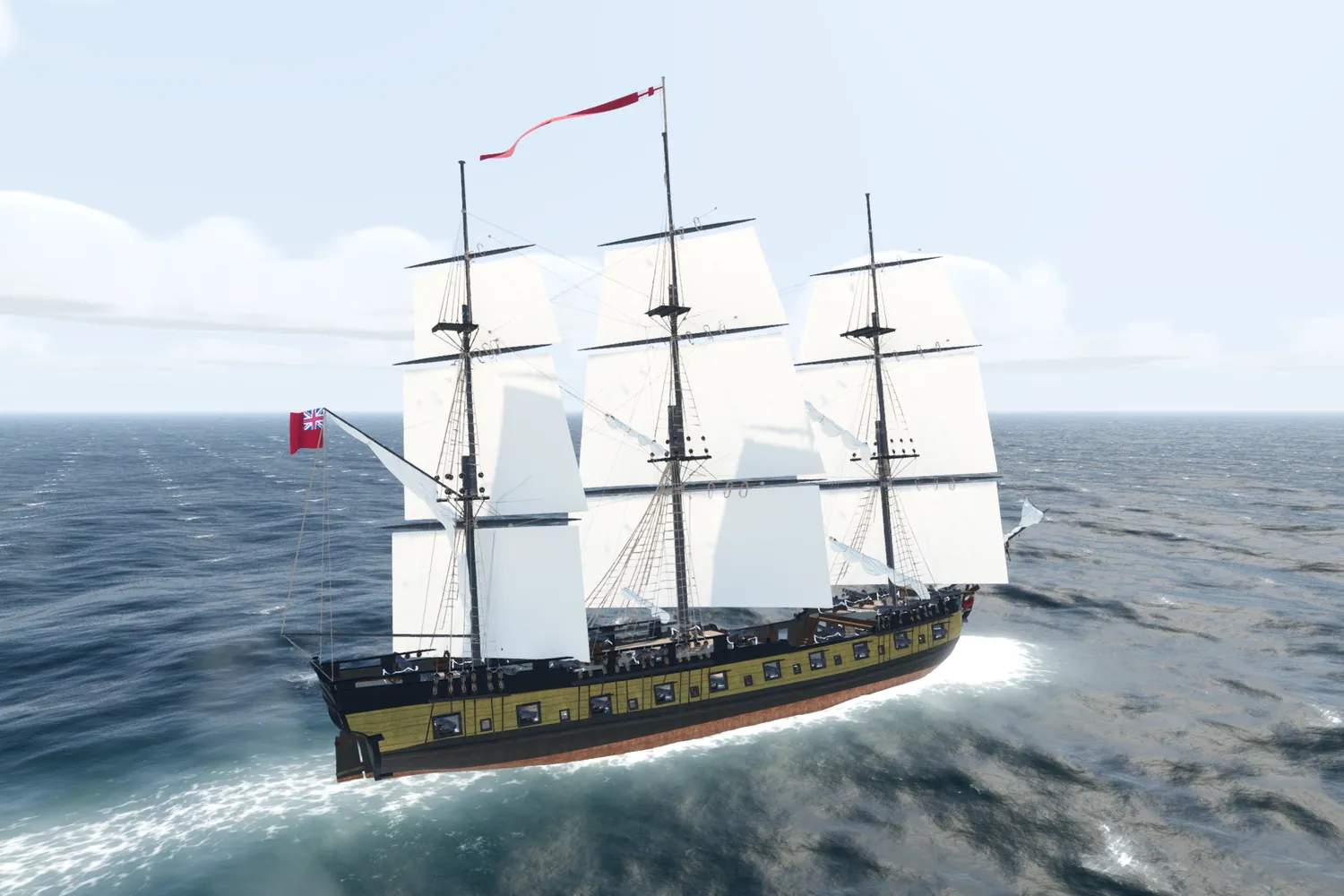
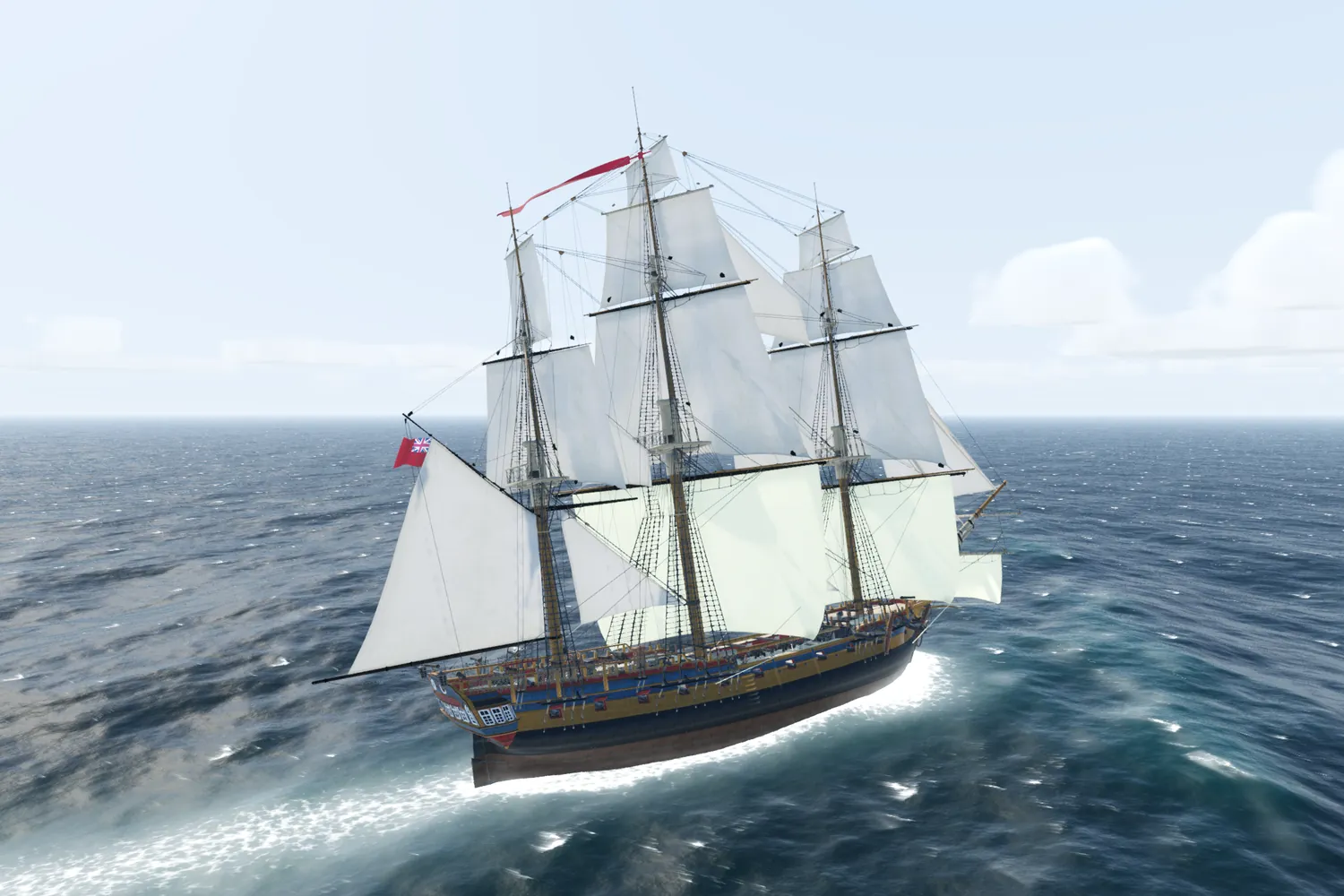
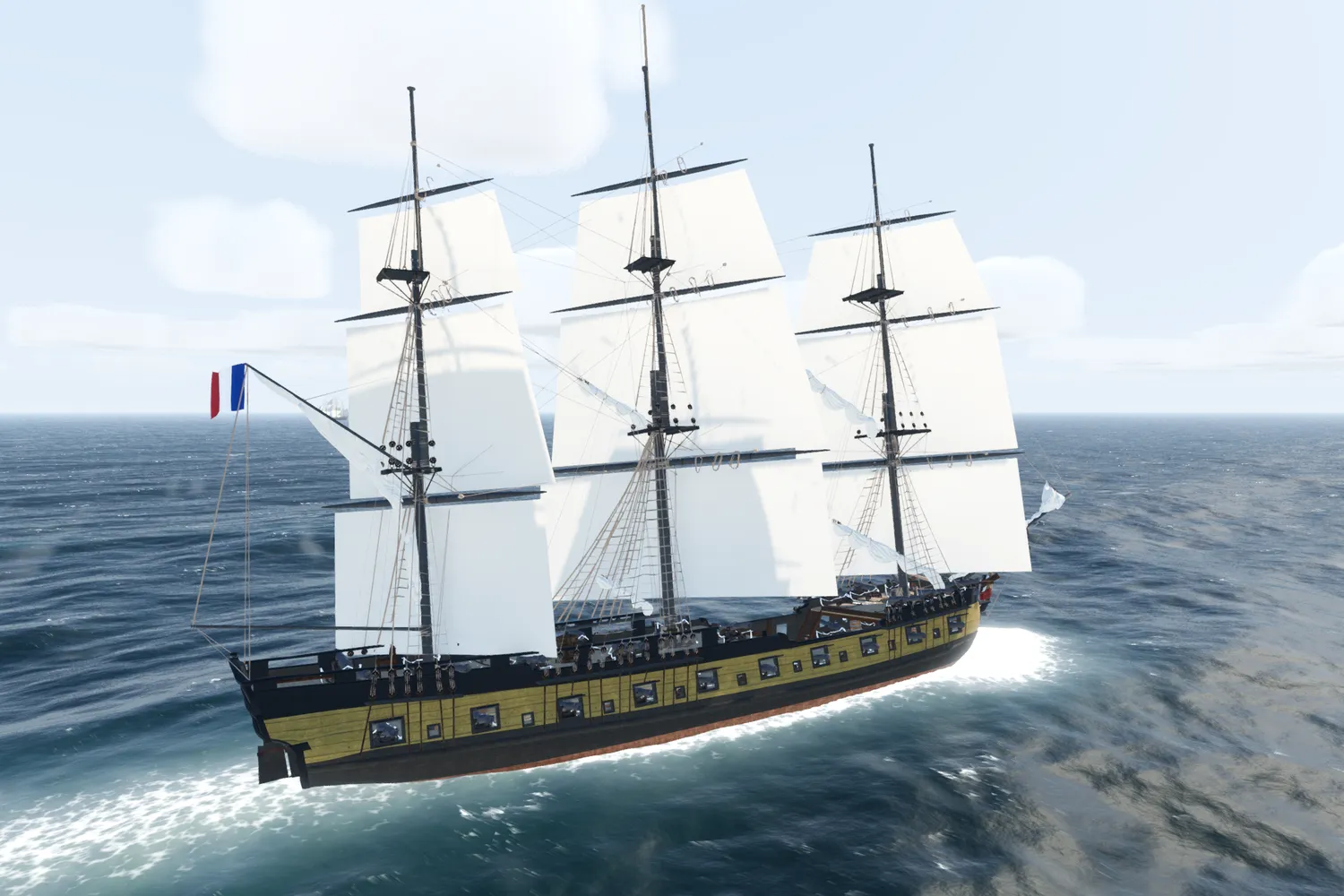
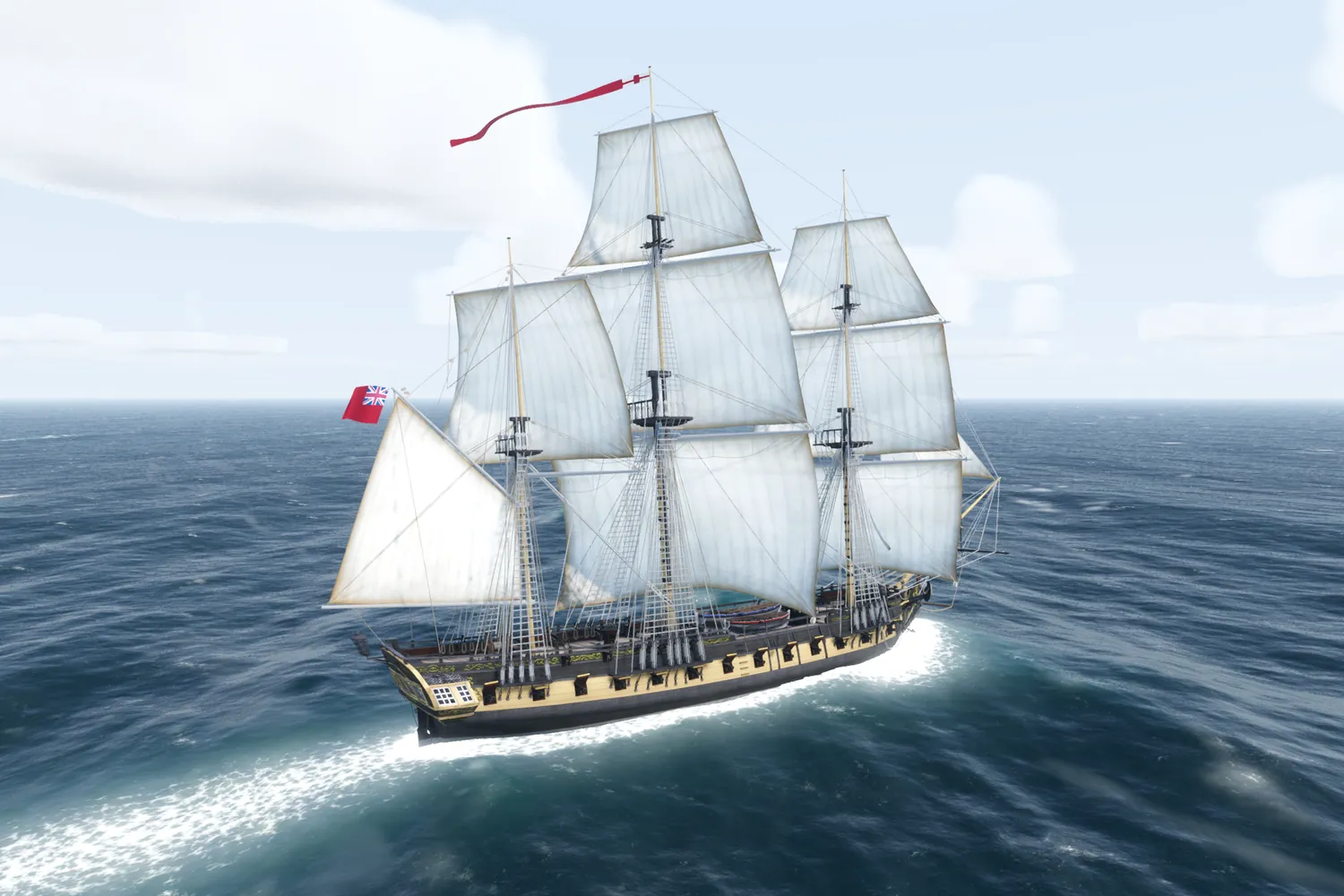
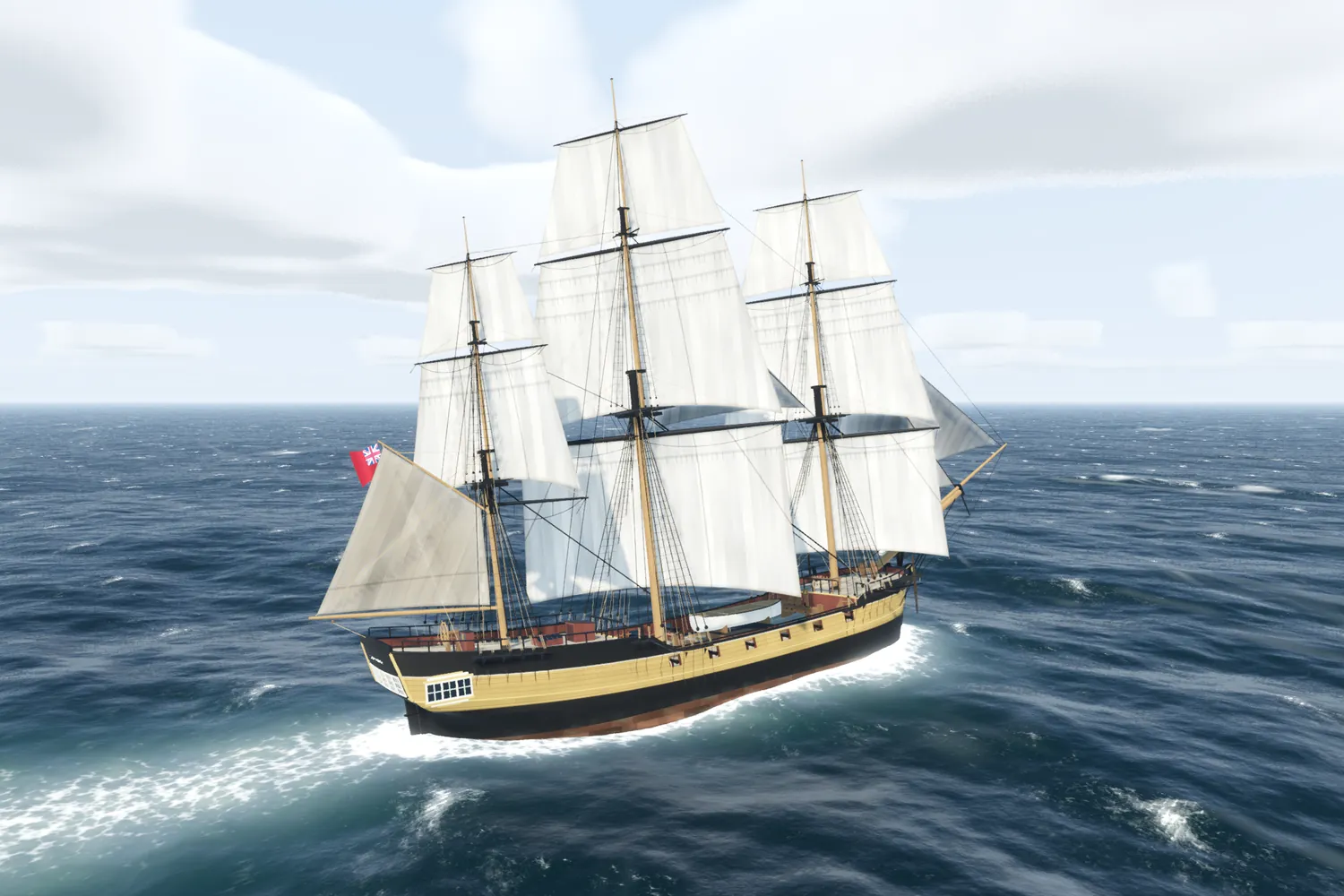
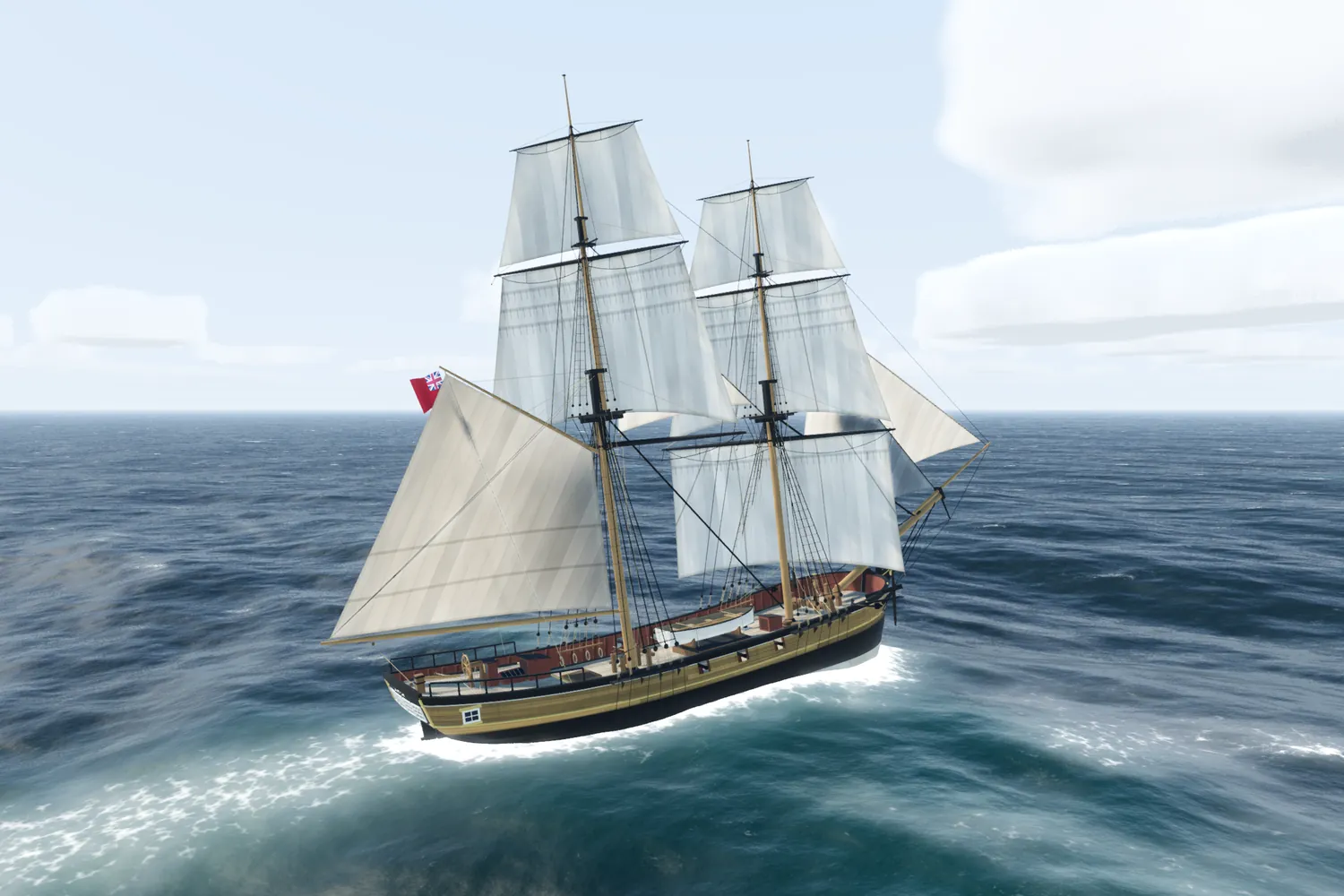
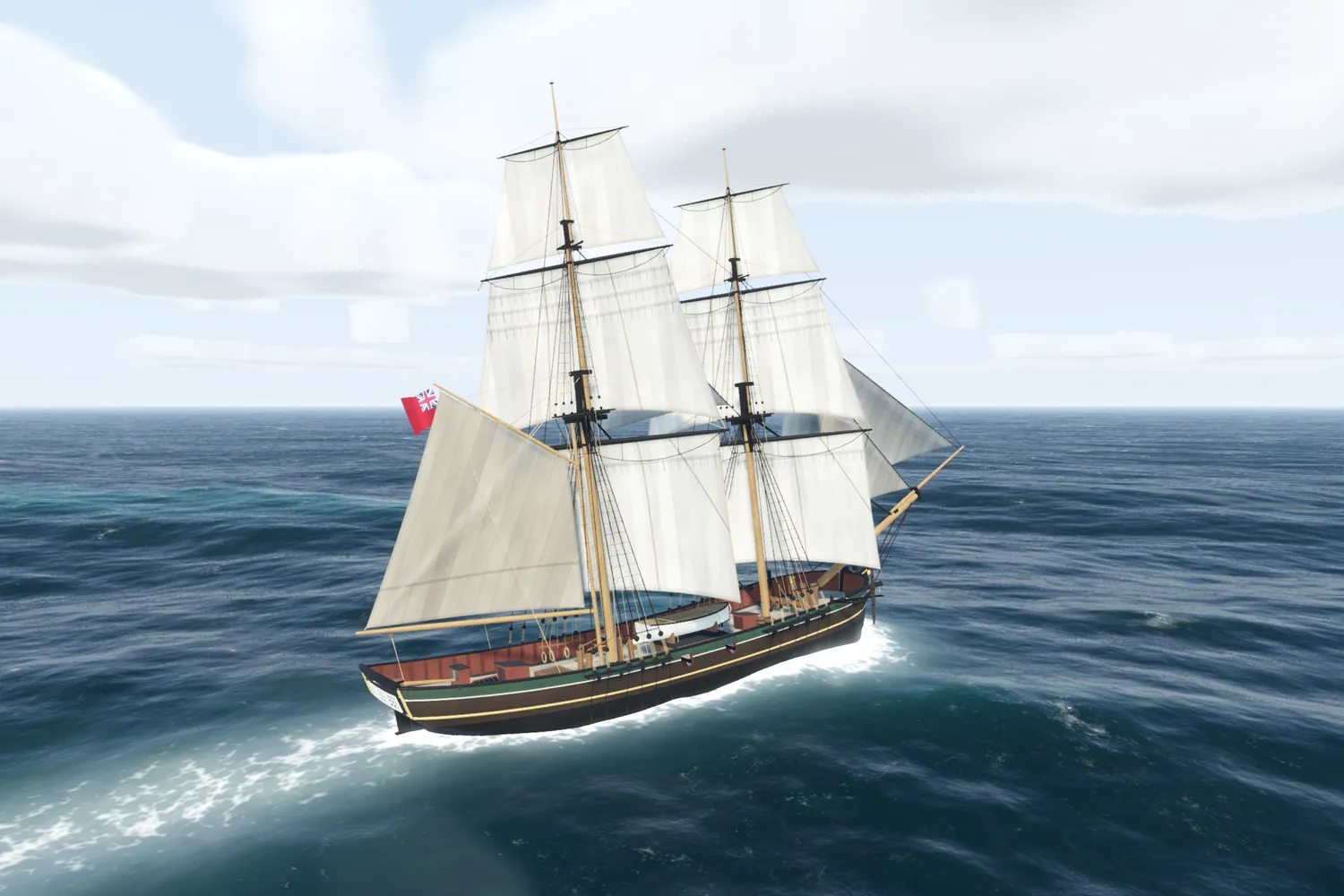
18 ships you will meet, fight, take or command, from a 10-gun cutter to the 136-gun Santísima Trinidad. Every picture is the ship as she sails in the game; every story is from the record, and anything we have not yet checked is marked (confirm).

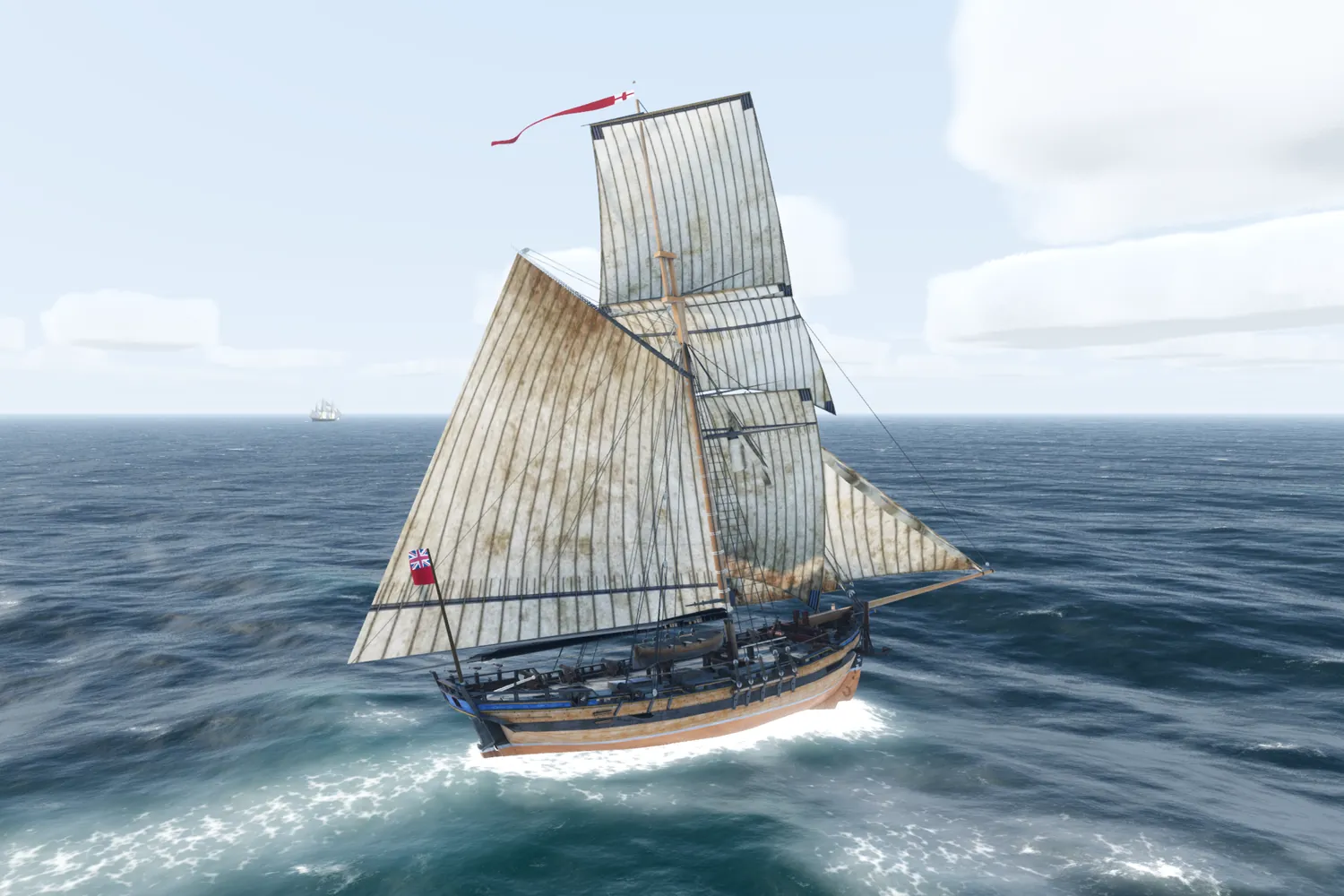
Cutter, photographed in the game under all plain sail.

Cutter

10-gun naval cutter

Guns
10
Men
60
Length
21.1 m

About this ship

The smallest command a lieutenant could hope for. One mast, an enormous gaff mainsail and a bowsprit that could be run in made the cutter fast and weatherly, and she did the work nobody else had time for: carrying despatches, chasing smugglers and luggers, and watching an enemy port from close inshore.

Through the close blockade of Brest from 1803, cutters and small craft of the inshore squadron lay off the Goulet in all weathers, near enough to count the French topmasts and signal the moment they moved (confirm).

In the game. Modelled on HMS Alert, a cutter of 1777, coppered and scaled to her real gun-deck length of 21.1 m. A cutter is a common first command.
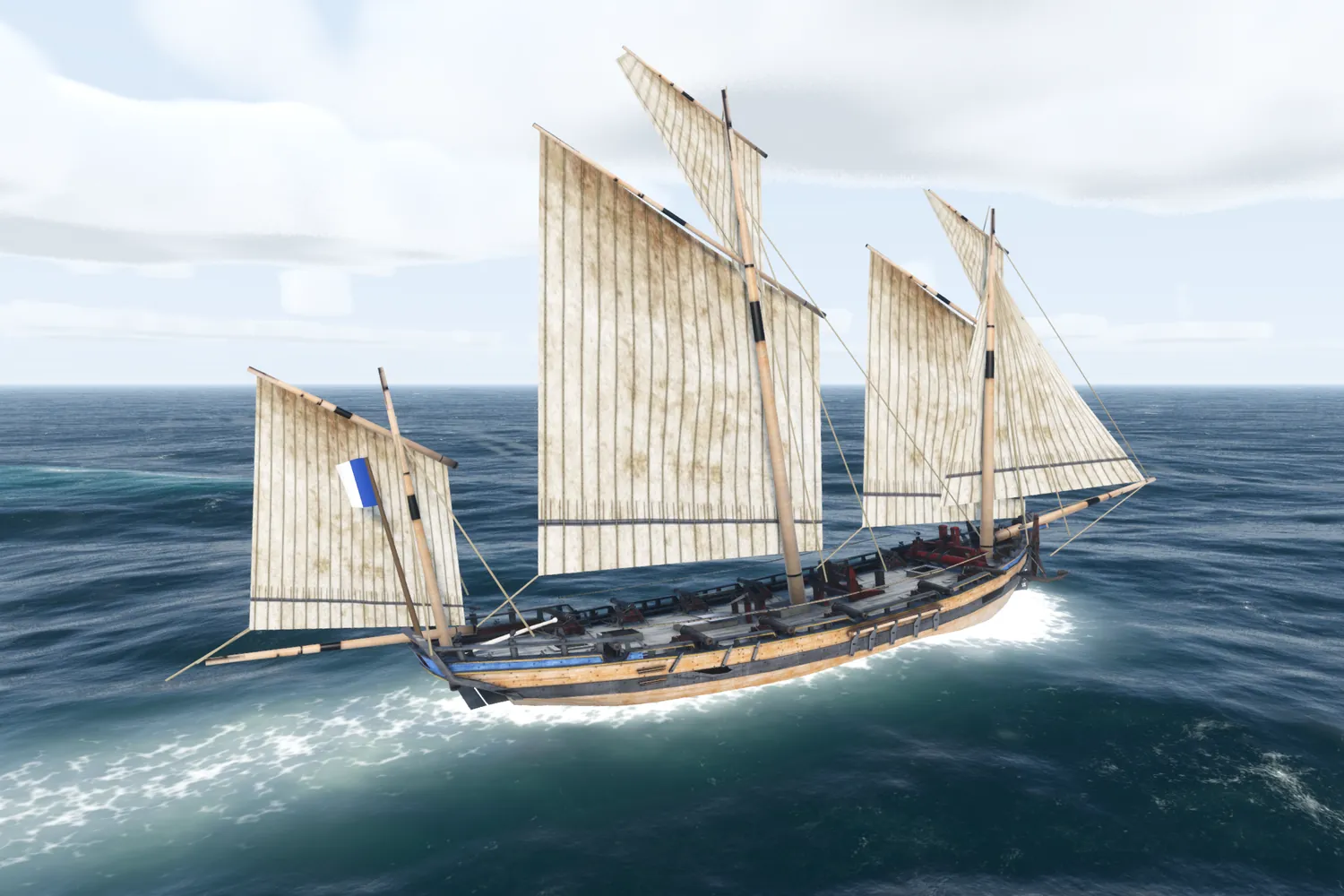
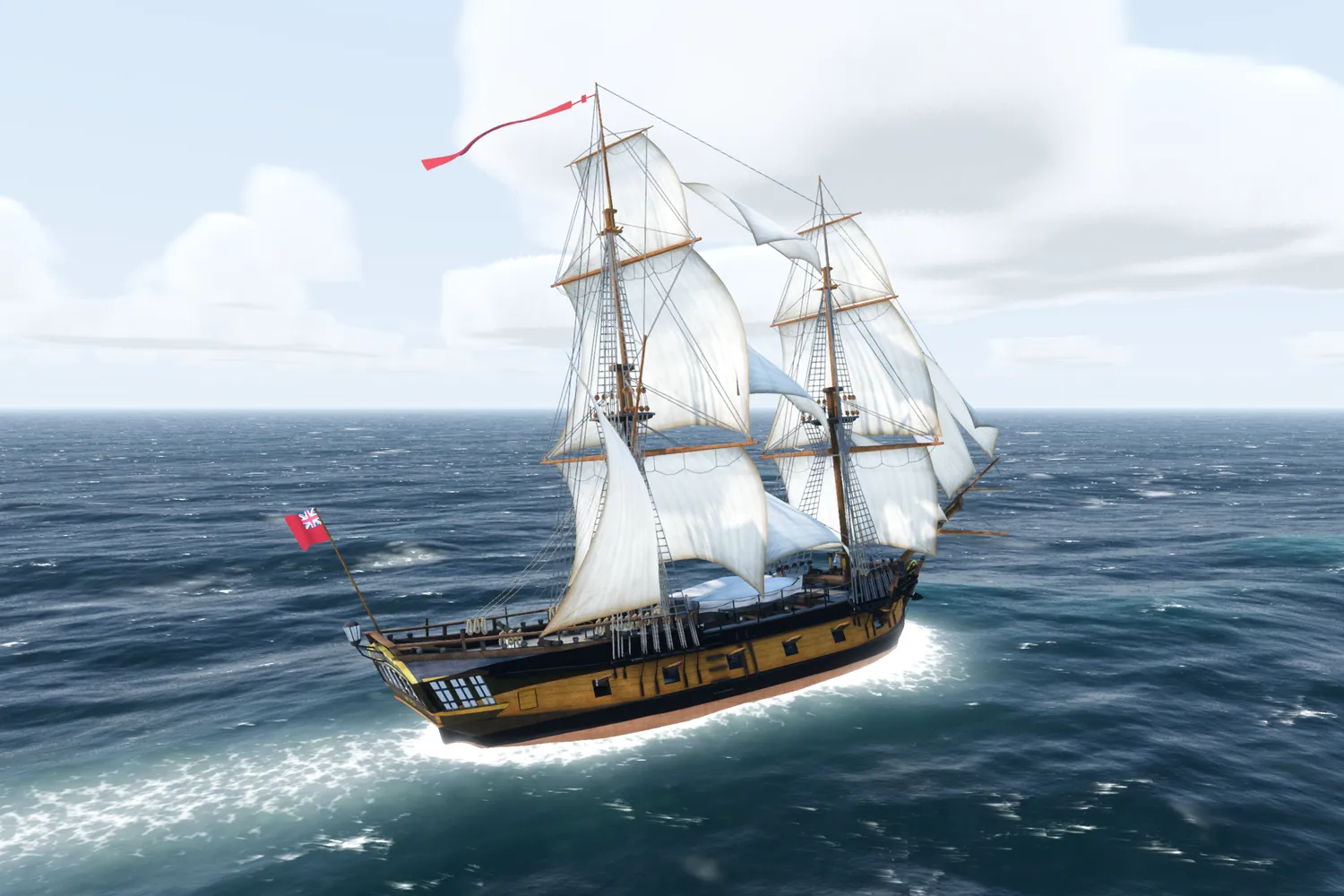
Privateer lugger, photographed in the game under all plain sail.

Privateer lugger

14-gun French privateer lugger (chasse-marée)

Guns
14
Men
80
Length
25 m

About this ship

The Breton chasse-marée carried three tall lugsails and could lie closer to the wind than any square-rigger sent to catch her. Fitted out as privateers at Saint-Malo, Morlaix, Dunkirk and Boulogne, luggers packed in far more men than they needed to sail, because every merchantman taken needed a prize crew to bring her home.

When war returned in May 1803 the Channel filled with them again. Losses to privateers are one reason Parliament had made convoy compulsory for most British merchantmen in 1798 (confirm the Act's scope).

In the game. Playable in the privateer career. Our own three-lug rig on the Alert's hull, left uncoppered as many privateer luggers were (confirm).

Brig-sloop, photographed in the game under all plain sail.

Brig-sloop

18-gun brig-sloop, Cruizer class

Guns
18
Men
120
Length
30 m

About this ship

Two masts, square-rigged, and a commander's command. The Cruizer class of 1797 carried sixteen 32-pounder carronades and two long 6-pounders, and more were built than of any other class of warship in the age of sail (over 100, confirm).

The most famous small-ship action of the period was fought by a smaller brig. On 6 May 1801, off Barcelona, Lord Cochrane's Speedy, fourteen 4-pounders and 54 men, ran in under the guns of the Spanish xebec-frigate Gamo, 32 guns and more than 300 men, so close that Gamo's broadsides passed over her. Then almost every man in Speedy boarded, and Gamo struck. Patrick O'Brian gave the action to Jack Aubrey's Sophie in Master and Commander. Speedy herself was taken by Linois's squadron two months later, on 3 July 1801.

In the game. The game's brig-sloop is the bigger 18-gun type that replaced brigs like Speedy. Modelled on HMS Ontario, a snow of 1780, scaled to Cruizer size, with black and ochre sides. A privateer can buy a 16-gun brig of the same model, the second ship on the privateer ladder (level 3).

Ship-sloop, photographed in the game under all plain sail.

Ship-sloop

18-gun ship-sloop

Guns
18
Men
121
Length
33 m

About this ship

The same rank of command as a brig-sloop, but on three masts, which made her handier in stays and easier to keep sailing when a mast was hit. Ship-sloops escorted convoys, harried enemy trade on distant stations, and were the last step before a post captain's frigate.

On 4 February 1805, off the Algerian coast, the sloop Arrow and the bomb Acheron turned to fight the French frigates Hortense and Incorruptible so that their convoy from Malta could scatter. Both were taken and Arrow sank soon after, but nearly all the convoy escaped (confirm the numbers).

In the game. Made from a museum model of an Aleksandr-class archipelago frigate, scanned by the Finnish Heritage Agency, then rigged with set sails and coppered. The same model draws the privateer corvette.

24-gun post ship, photographed in the game under all plain sail.

24-gun post ship

24-gun sixth rate

Guns
24
Men
160
Length
36 m

About this ship

The smallest ship a post captain could command: one gun deck of 9-pounders and a few carronades above. Bigger frigates were taking over by 1800, but post ships still did convoy, cruising and survey work on every station.

The model is HMS Pandora, sent to the Pacific in 1790 to bring back the Bounty mutineers. She found fourteen of them on Tahiti, then struck the Great Barrier Reef on 29 August 1791 and sank; her wreck lies there still.

In the game. Also the ship-rigged privateer of 20 to 22 guns.

Privateer corvette, photographed in the game under all plain sail.

Privateer corvette

26-gun privateer corvette, flush-decked

Guns
26
Men
180
Length
38 m

About this ship

Not a navy ship at all: a corvette built on speculation by a privateering syndicate, flush-decked, fast, and carrying far more men than a merchantman of her size, so that every ship she took could be manned and sent home. The great privateering ports, Saint-Malo, Bordeaux and Nantes, built them to outsail anything they could not outfight.

The Blonde of Bordeaux, 550 tons and about 30 guns, was one of the most feared. Under François Aregnaudeau she took the East Indiaman Culland's Grove in July 1803, and on 24 March 1804 she fell on a Newfoundland convoy and fought its escort, the 14-gun sloop HMS Wolverine, for an hour until Wolverine struck and sank (some accounts give 21 March). The frigate HMS Loire ran her down that August after a 20-hour chase, and Aregnaudeau went to England a prisoner.

In the game. Playable in the privateer career: sold to a captain of level 9, between the 22-gun ship-rigged privateer and the 34-gun private frigate. Drawn with the Aleksandr ship-sloop model, so she no longer looks like the post ship.

Frigate, photographed in the game under all plain sail.

Frigate

38-gun frigate, fifth rate (also the 32s and 36s)

Guns
32 to 38
Men
220 to 280
Length
40 to 46 m

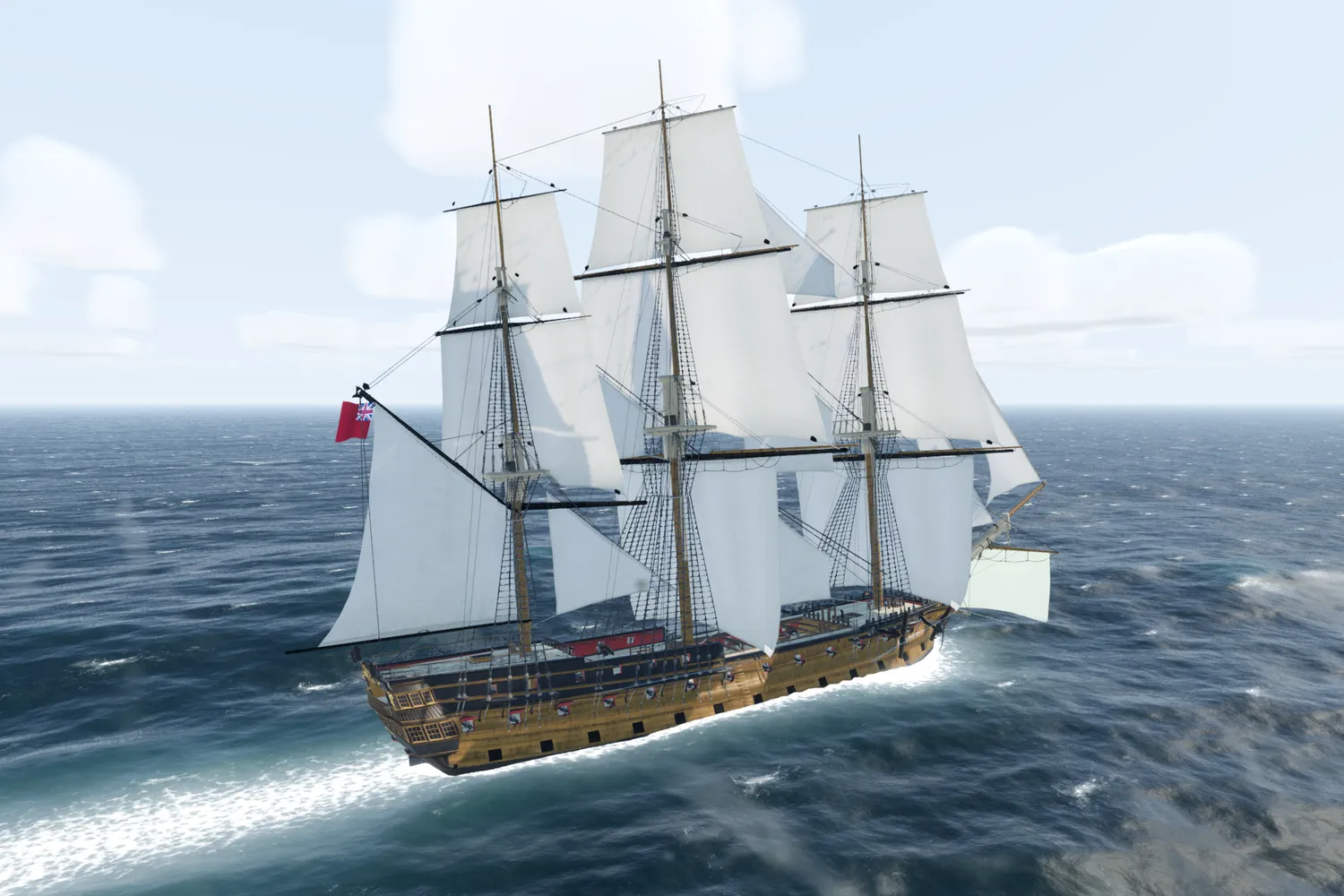
About this ship

The eyes of the fleet and every officer's dream: fast enough to run from a ship of the line, strong enough to fight anything her own size, and free to cruise alone for months, taking prizes. A British 38 carried twenty-eight 18-pounders on her gun deck.

On 5 October 1804, off Cape Santa Maria, Commodore Graham Moore's four frigates stopped four Spanish frigates carrying treasure from the River Plate to Cádiz, though Spain was still at peace. The Mercedes blew up with nearly all on board; the other three were taken with their silver and gold, and Spain declared war that December. Because the ships were seized before war was declared, the treasure went to the Crown as droits of Admiralty, and the captors received only a grant from it (confirm).

In the game. Modelled on L'Aurore, a French 38 of 1765, re-rigged with a gaff driver. About one frigate in five still carries the old lateen mizzen, more in Spanish, Dutch and Ottoman service. The privateer career's top ship, the 34-gun private frigate, is drawn with her too.

American 44, photographed in the game under all plain sail.

American 44

44-gun heavy frigate, United States Navy

Guns
44
Men
450
Length
53.3 m

About this ship

Joshua Humphreys' answer for a young navy that could not afford ships of the line: frigates long and strong enough to beat any frigate and outrun any two-decker. Constitution, launched at Boston in 1797, carried thirty 24-pounders on her gun deck.

In 1803 she became Commodore Edward Preble's flagship in the war with Tripoli. From his squadron, on the night of 16 February 1804, Lieutenant Stephen Decatur took the ketch Intrepid into Tripoli harbour and burned the captured American frigate Philadelphia under the guns of the forts.

In the game. Constitution and President sail the chart as named ships in the War of 1812.

50-gun ship, photographed in the game under all plain sail.

50-gun ship

50-gun fourth rate

Guns
50
Men
350
Length
45 m

About this ship

Too weak for the line of battle by 1800 and too big for a frigate's work, the fifty found her place as a flagship on distant stations, a convoy escort and a troopship.

HMS Leopard (1790) is remembered for 22 June 1807, when she fired into the American frigate Chesapeake off Cape Henry to take back deserters, one of the long roads to the War of 1812. O'Brian readers know her too: in Desolation Island Jack Aubrey sails her for Botany Bay and meets the ice.

In the game. Met at sea as a flagship or convoy escort; captains are no longer given one after their frigate. The model is HMS Leopard herself, at life size.

64-gun ship, photographed in the game under all plain sail.

64-gun ship

64-gun third rate

Guns
64
Men
500
Length
49 m

About this ship

The smallest ship of the line, cheaper to build and man than a 74. Many were still in service in 1800, but almost no new ones were ordered.

HMS Agamemnon was Nelson's favourite; he commanded her from 1793 to 1796. At Copenhagen on 2 April 1801 she grounded on the Middle Ground shoal before she could get into action, and at Trafalgar she fought under Sir Edward Berry.

In the game. A British or Spanish frigate captain's next command after the 38 is a 64, as it usually was in life. Her hull also makes the game's East Indiaman.

74-gun ship, photographed in the game under all plain sail.

74-gun ship

74-gun third rate

Guns
74
Men
590
Length
55 m

About this ship

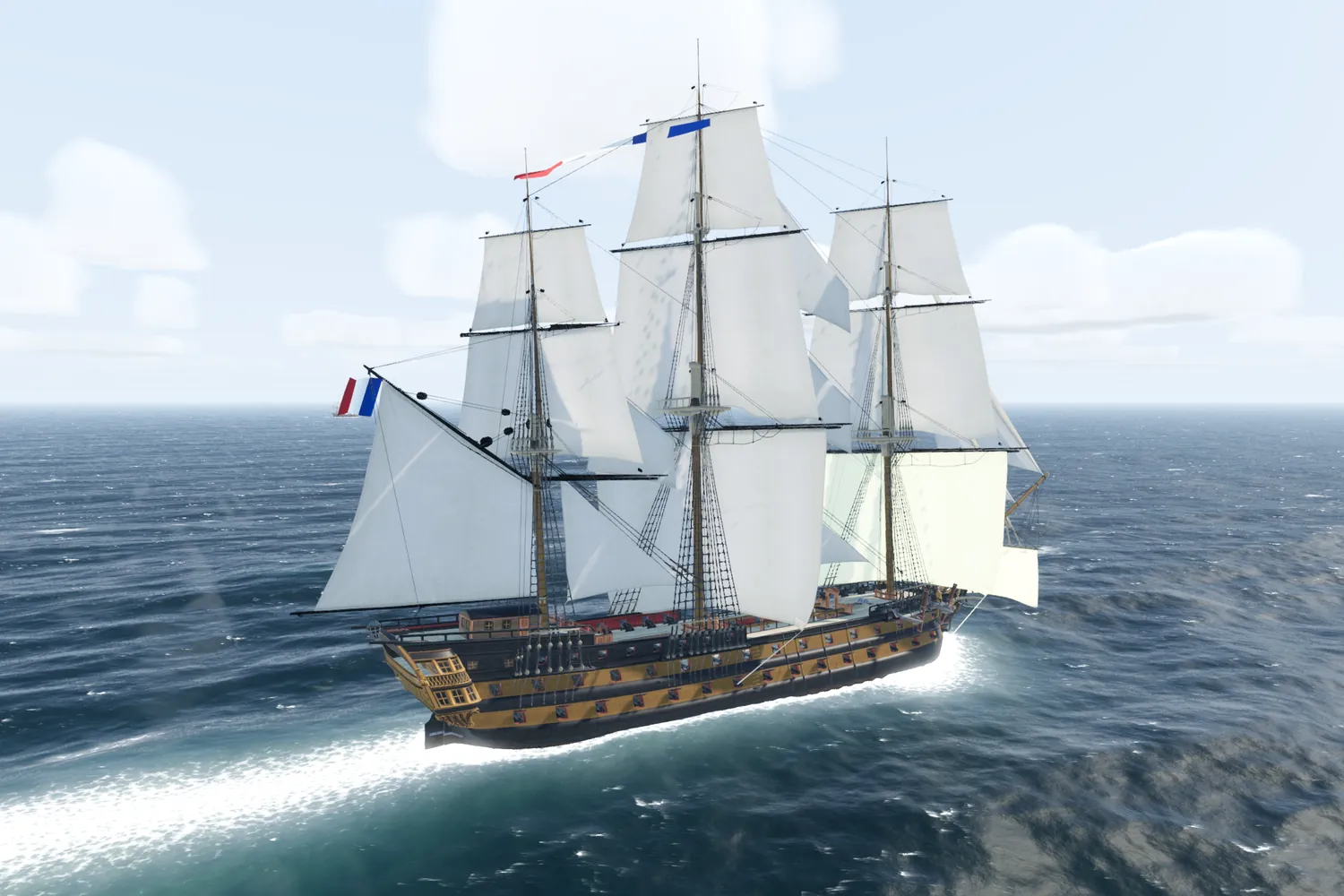
The backbone of every battle fleet: two gun decks, a balance of firepower, speed and cost that every navy copied. Most of the ships at Trafalgar on both sides were 74s.

This one was launched at Rochefort in 1800 as the Duguay-Trouin. She fought at Trafalgar and got away, only to be caught off Cape Ortegal by Sir Richard Strachan's squadron on 4 November 1805. As HMS Implacable she lasted until 1949, when she was scuttled in the Channel; her stern gallery and figurehead are at the National Maritime Museum, Greenwich.

In the game. A French captain goes straight from the 38 to a 74, since France had no 50s or 64s in commission in 1800. About a third of 74s carry an older hull, HMS Bellona of 1760.

80-gun ship, photographed in the game under all plain sail.

80-gun ship

80-gun two-decker

Guns
80
Men
840
Length
59 m

About this ship

France and Spain built big two-deckers of 80 guns, nearly as strong as a three-decker and much faster under sail.

Bucentaure, launched at Toulon in 1803, was Admiral Villeneuve's flagship at Trafalgar. Victory passed close under her stern and fired her broadside through the stern windows, the most destructive single broadside of the day (confirm). Bucentaure struck that afternoon, broke loose in the storm that followed, and was wrecked off Cádiz.

In the game. In the practice menu: Victory against Bucentaure, either side.

First rate, photographed in the game under all plain sail.

First rate

100-gun first rate (Victory carried 104 in 1805)

Guns
100 to 104
Men
820
Length
57 m

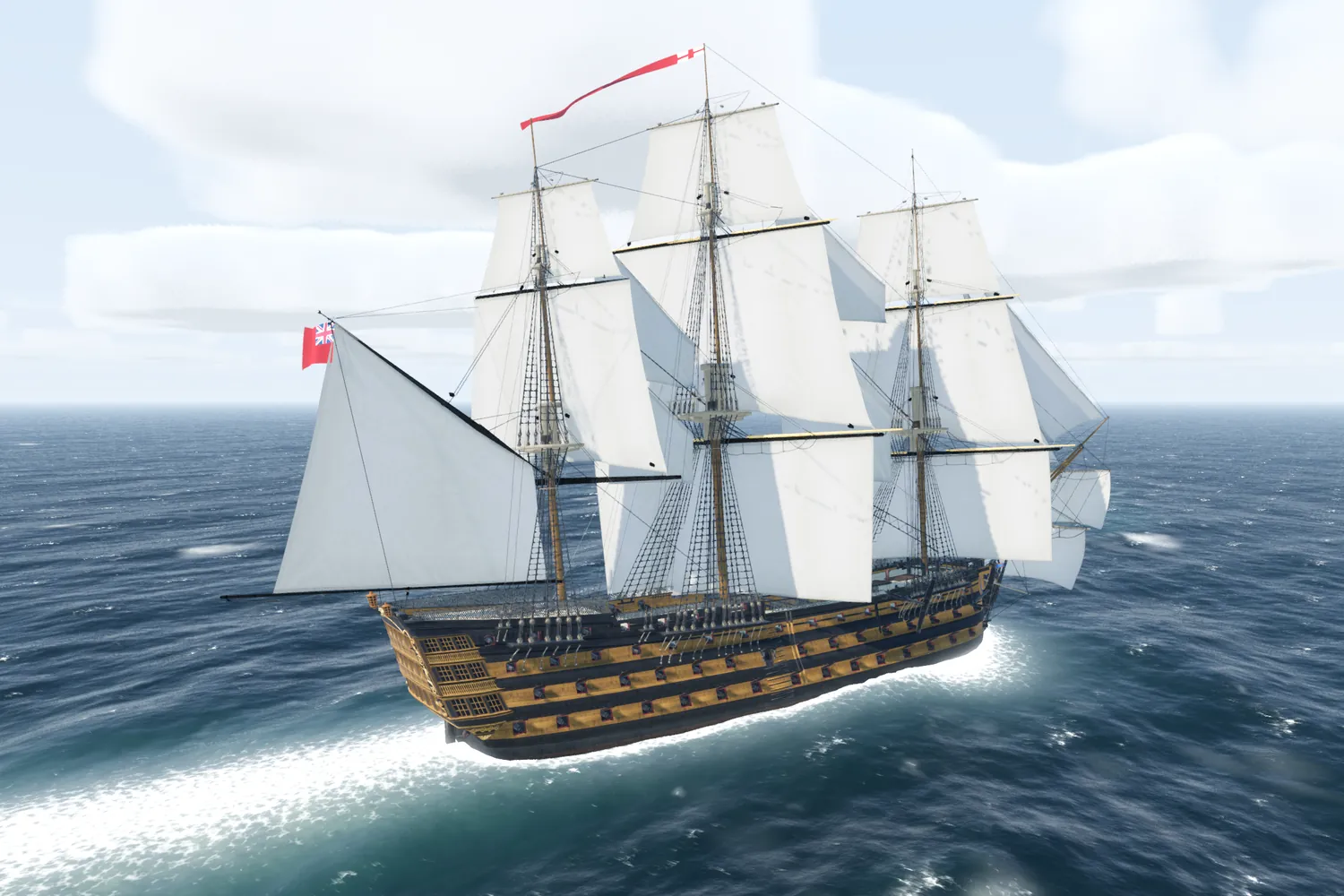
About this ship

Three gun decks, the biggest and costliest ships in the Navy, built to carry an admiral's flag. Victory, launched in 1765, had just come out of a great repair at Chatham (1800 to 1803) when Nelson hoisted his flag in her in May 1803.

She led the weather column into the allied line at Trafalgar on 21 October 1805, where Nelson was shot on her quarterdeck and died below as the battle was won. She is still in commission at Portsmouth.

In the game. Also stands in for the British 98s, the Spanish 112s and the French 118s, drawn at her size.

Santísima Trinidad, photographed in the game under all plain sail.

Santísima Trinidad

136-gun four-decker, Spanish Navy

Guns
136
Men
1,050
Length
61 m

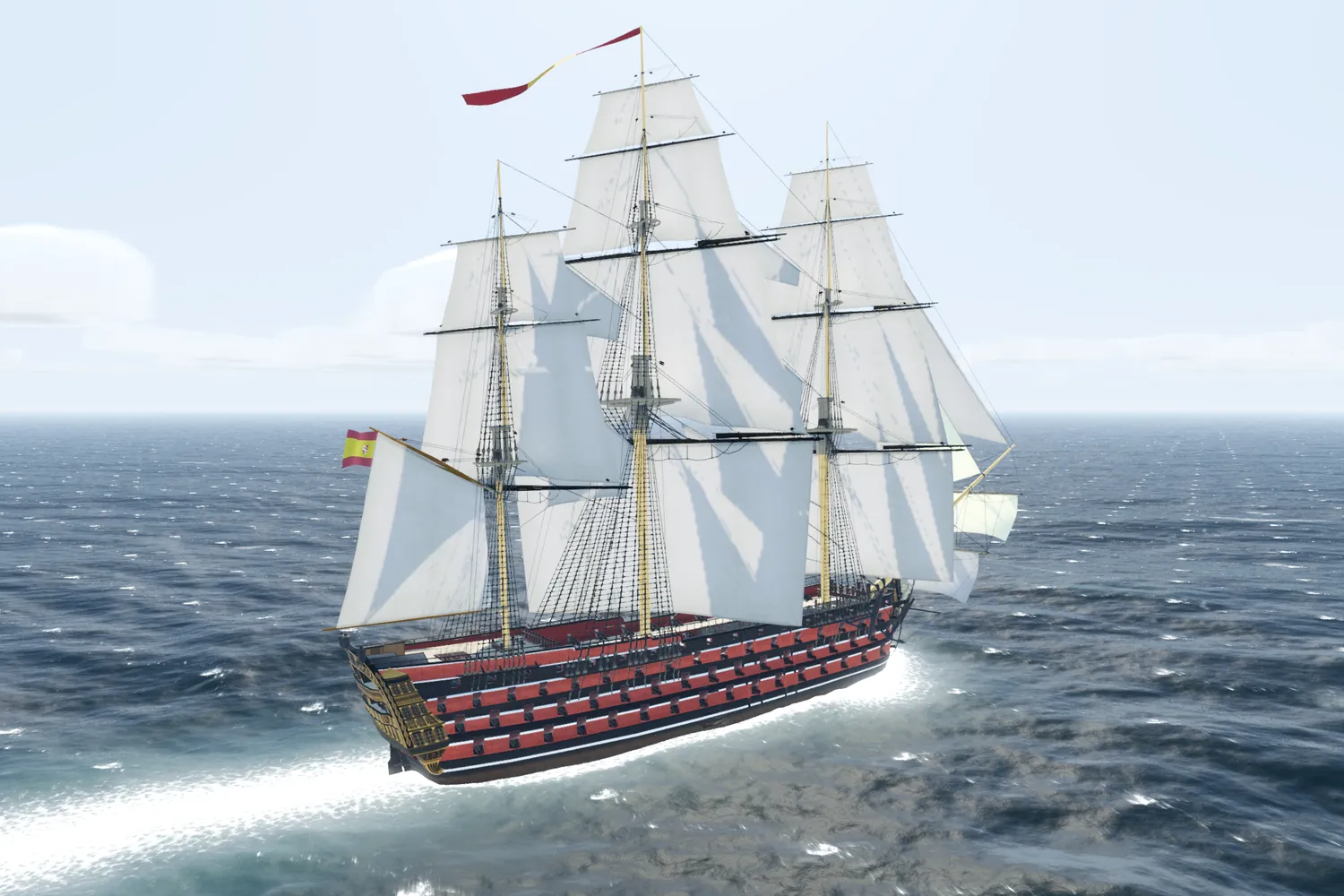
About this ship

Built at Havana in 1769, she was the largest warship in the world, and in 1795 her upper decks were joined to make a fourth tier of guns.

At Trafalgar she flew the flag of Rear-Admiral Báltasar Hidalgo de Cisneros. Dismasted and taken, she was too badly damaged to save and sank in the storm a few days after the battle.

In the game. One of a kind: she sails the chart as herself.

East Indiaman, photographed in the game under all plain sail.

East Indiaman

About 1,200 tons, Honourable East India Company

Guns
30
Men
130
Length
49 m

About this ship

The Company's ships were the largest merchantmen afloat, painted to look like frigates and armed to keep pirates and privateers at a distance. Every one taken was a fortune in tea, silk and silver.

On 15 February 1804, off Pulo Aura, Commodore Nathaniel Dance in the Earl Camden was bringing the China fleet home when Admiral Linois's squadron, led by the 74 Marengo, came down on it. Dance formed his Indiamen into a line of battle as if they were men-of-war, and after a short exchange of fire Linois drew off. Dance was knighted. Not every Indiaman was so lucky: on 7 October 1800 Robert Surcouf's privateer Confiance boarded and took the Kent near the mouth of the Hooghly.

In the game. Linois and the Marengo sail the chart. The model is the 64's hull with her lower ports painted shut.

West Indiaman, photographed in the game under all plain sail.

West Indiaman

About 350 tons, ship-rigged

Guns
12
Men
40
Length
33 m

About this ship

Sugar, rum, coffee and cotton came home from Jamaica and the Leeward Islands in ships like this, sailing in great convoys that could number a hundred sail or more (confirm). Many carried a letter of marque, which let them take any enemy ship they met.

A homeward convoy scattered by a gale was the privateer's best hope, and the reason a lone West Indiaman kept a good lookout.

In the game. Our own model, built from period figures after Steel (1805) and Chapman (1768). Armed, she is also the letter of marque.

Merchant brig, photographed in the game under all plain sail.

Merchant brig

About 190 tons

Guns
6
Men
20
Length
25 m

About this ship

The workhorse of the coasting, Baltic and short-sea trades: coal from the Tyne, timber and hemp from the Baltic, wine from Oporto, and the packets that carried the mails.

Small, slow and lightly manned, she was the commonest prize of all, and the one a privateer could most easily send home.

In the game. Our own model: rig after Steel (1794), hull after Chapman (1768).

Snow, photographed in the game under all plain sail.

Snow

About 130 tons

Guns
4
Men
14
Length
22 m

About this ship

To a landsman she is a brig. To a seaman she is a snow, because her trysail is hooped to a small separate mast just abaft the mainmast instead of to the mainmast itself.

Snows were everywhere in the coastal and colonial trades, and the rig was common in small warships too: HMS Ontario, whose model makes the game's brig-sloop, was built as one.

In the game. Our own model.

Model credits

Pictures are photographs taken in the game. These ship models are used under CC BY 4.0 and changed by us (re-rigged, repainted, rescaled):

The cutter, brig-sloop, lugger, frigate and older 74 are licensed models; the merchant brig, snow and West Indiaman are our own.